
Quick Answer
A refinery MRO team should demand a delayed coker valve repair shop with hands-on coker experience, full in-house machining and welding, documented NDE, OEM authorizations, live cycle testing, and a written scope that addresses thermal fatigue, hard-facing wear, and seat leakage. Anything less risks a failed valve mid run.
Delayed coker units run some of the most punishing service in any Gulf Coast refinery. The unheaded, switch, and isolation valves on a coker drum see 900-degree Fahrenheit residue, thermal cycling on a 16- to 24-hour drum schedule, abrasive coke fines, and steam-quench shocks that destroy lesser valves within months. When an MRO manager at a Texas City, Port Arthur, or Beaumont refinery sends a coker valve out for repair, the work that comes back has to perform on a unit that does not forgive shortcuts. This article outlines what to demand of the shop before, during, and after the rebuild.
How a Coker Valve Repair Should Actually Run
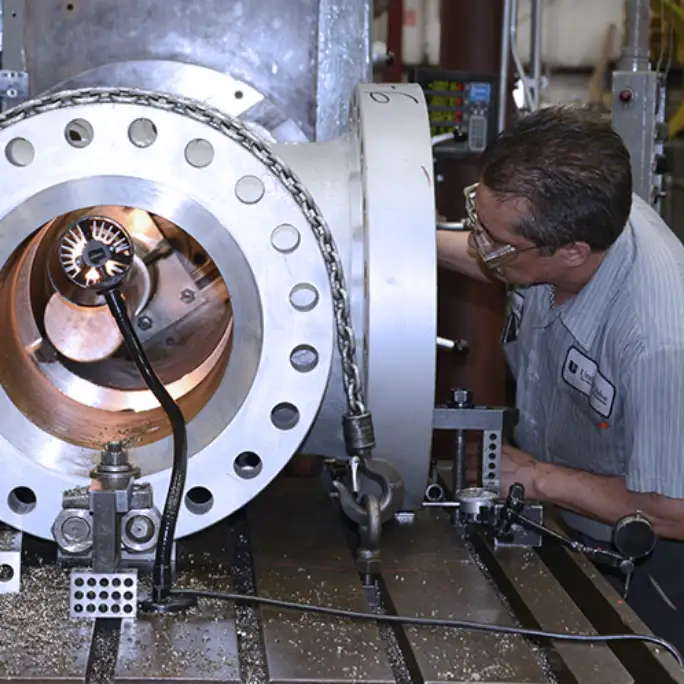 A real delayed coker repair is not a generic gate or ball valve rebuild with a coker label slapped on the work order. The process is specific to the service, and it follows a sequence that any qualified shop should be able to walk you through:
- Receipt and incoming inspection. The valve arrives with coke buildup, often heavy. It is cleaned, photographed, and documented. Tag numbers, heat codes, and any OEM markings are recorded before disassembly so traceability is preserved.
- Teardown and root cause review. Disassembly is done with the understanding that the failure pattern matters. Galled stems, eroded seats, cracked overlays, and warped bodies each point to different upstream issues. A shop that just cleans and reassembles is missing the point.
- Dimensional inspection. Seat pockets, stem bores, body wear surfaces, and trim components are measured against OEM drawings. Out-of-tolerance dimensions trigger machining or component replacement, not workarounds.
- NDE on critical surfaces. Magnetic particle inspection on ferritic body welds, dye penetrant testing on austenitic overlay surfaces, and radiography on suspect castings. Coker service generates thermal fatigue cracks that surface inspection alone will miss.
- Weld overlay and trim rework. Hard-faced surfaces are rebuilt with Stellite 6 or 21, depending on the original spec. The overlay is machined back to OEM geometry, not just ground smooth. Geometry drives seat tightness on a coker valve more than surface finish.
- Hydrostatic and seat leak testing. The valve is tested per API 598 or the customer specification, with leak rates logged. A coker isolation valve that passes shell test but fails seat test goes back to the bench.
- Functional cycle testing. Where the shop has the capability, the valve is cycled under simulated service to confirm the actuator, packing, and trim move together. This is the test that catches problems that static hydrotest cannot.
Houston shops that handle delayed coker valve repair at scale typically run this full sequence on every unit. Shops that treat coker work as just another gate valve job tend to skip cycle testing and overlay machining, and the valve goes back to the refinery looking clean but underperforming.
What Goes Wrong on a Coker Valve and What It Costs the Refinery
Coker valve failures rarely happen in isolation. A single bad valve disrupts the drum cycle and forces operations to manage around it for weeks until the next planned outage. MRO teams should understand the failure modes that justify aggressive repair specifications:
- Thermal fatigue cracking. The drum quench cycle drives the body and trim through hundreds of degrees of swing every few hours. Castings develop hairline cracks at stress risers. Without radiography or magnetic particle on incoming and outgoing valves, these cracks ship back into service.
- Erosive seat wear. Coke fines act like sandblasting media across the seat. Hard facing wear that looks cosmetic on inspection causes hard seat leak rates that climb across a run, and by month nine the valve cannot hold differential pressure.
- Stem galling. High-temperature service with thermal cycling galling the stem and bushing surfaces. A stem that binds is a stem that strips an actuator gear, and the next failure is on the valve actuation package, not the valve itself.
- Packing burnout. Coker temperatures destroy packing that was never rated for the service. The valve leaks process to atmosphere and triggers a regulatory event. Repacking is not optional on a coker rebuild.
- Body distortion. Sustained thermal cycling warps bodies, especially on large-diameter switch valves. A distorted body will not hold seat geometry no matter how good the trim is. The shop should be measuring body squareness, not assuming it.
The cost of a failed coker valve mid run is real money. An unplanned drum bypass to manage a leaking switch valve hurts throughput. A failure that takes the unit down ahead of turnaround burns refinery margin at coker economics. MRO teams who push hard on repair scope are protecting unit reliability, not being difficult.
Why Coker Valve Shops Are Not Created Equal
The phrase coker valve repair gets used loosely. The real differentiators between shops show up in capability, not marketing:
Large diameter handling. Coker isolation and switch valves run from 12 inches to 30 inches and weigh tens of thousands of pounds. A shop without serious crane capacity and floor space will struggle to handle the iron, and the work suffers when the valve cannot be set squarely on the bench. Large diameter valve repair capability is the entry ticket, not the headline.
Welding qualifications. Coker overlay work means weld procedures qualified for the alloy combinations involved, including Stellite over carbon steel, Inconel buttering, and post weld heat treat where required. A shop without a welding engineer and qualified WPS for these procedures will produce overlays that crack in service. Ask to see the WPS list.
OEM authorizations. The major coker valve OEMs, including Velan, OMB, and others, each have specific rebuild procedures, parts lists, and warranty implications. Working with a shop that holds the OEM authorization protects the asset owner from warranty disputes and ensures the right parts are used the first time.
Cycle test capacity. Most coker valve problems show up under cycle, not under static hydrotest. A shop that cannot cycle the valve before shipping is shipping unknowns. Ask whether functional cycle testing is part of the standard scope or an upcharge, and what the documentation looks like.
Engineering depth. Coker repair often surfaces a question about whether the original design is even appropriate for the current service. A shop with degreed engineers on staff can recommend trim upgrades or material changes that extend run length. A shop without that capability just reassembles whatever shipped in.
When to Repair, When to Replace, and When to Modify
- Repair when: the body shows no through-wall cracking, dimensions are within OEM tolerance after machining, trim can be rebuilt to spec, and the original metallurgy matches current service conditions.
- Modify when: the body and bonnet are sound but the trim metallurgy has been undersized for the actual service. Upgrading trim to a more wear-resistant alloy can double run length without replacing the valve.
- Replace when: radiography finds body cracking through wall, the body has lost wall thickness from erosion, or the valve is so far out of OEM tolerance that machining will not bring it back. Replacement is also the right call when a newer design eliminates a known failure mode.
- What happens if a marginal valve is repaired and returned: the shop ships a valve that passes static test, the refinery installs it during turnaround, and it fails inside the run window. The cost of that failure dwarfs the cost of replacement up front.
Field Examples Gulf Coast MRO Teams Will Recognize
A common scope: a Beaumont refinery sends in a fleet of 16 inch coker unheaders after a four year run. Incoming NDE finds heat affected zone cracking on three of eight bodies. Those three are scrapped, the remaining five are stripped to bare castings, trim is replaced with upgraded Stellite 21 overlay, packing is changed to a high-temperature graphite set, and each valve is cycled under hot service simulation before shipping. Run length on the rebuilt set extends from four years to a documented six on the next pull.
Another scope: a Texas City coker switch valve is sent in for a routine refurbishment. The shop calls the MRO manager because valve failure analysis shows the stem alloy was wrong for the service from day one. The MRO team approves a metallurgy upgrade, the modified valve returns, and the recurring stem galling that had cost three unplanned drum bypasses per year stops.
What Sets United Valve Apart on Coker Work
United Valve has been repairing delayed coker valves out of Houston since long before the Gulf Coast coker buildout of the 2000s. The 104,000-square-foot facility on Gulf Freeway sits within the refining belt that runs from Texas City through Beaumont, and our Corpus Christi shop serves lower Gulf Coast operators. Coker work is built into the shop, not a side service.
- Decades of delayed coker experience: a continuous track record on coker unheading, switch, and isolation valves for the major refiners along the Texas and Louisiana corridor, supported by degreed engineers and qualified welders.
- Reliability backed by documentation: every coker rebuild ships with full NDE certificates, hydrostatic test data, material traceability, and where specified, cycle test reports, all logged against the valve serial number.
- Vertically integrated technology: in-house multi-axis CNC machining, qualified welding procedures for hard face overlay, eight overhead bridge cranes with capacities to 40 tons, and complete engineering valve testing, including pressure, type, and fugitive emissions on the same site.
- Gulf Coast coverage that matches refinery schedules: Houston and Corpus Christi facilities, supplemented by mobilization-ready field service crews for turnaround support when the valve cannot leave the unit.
Frequently Asked Questions
How long does a typical delayed coker valve repair take?
A standard coker valve repair runs three to six weeks depending on size, the extent of overlay rework needed, and parts availability. Turnaround driven scopes with multiple valves are planned around the refinery outage schedule so all units return in time for re-installation. Rush work can compress that window when the shop has the capacity.
What documentation should accompany a repaired coker valve?
At minimum, the repair packet should include incoming and outgoing inspection reports, NDE certificates covering radiography, magnetic particle, and dye penetrant where applicable, material test reports for any replacement components, hydrostatic and seat test data per API 598 or the customer specification, and where included, functional cycle test results.
Can a shop upgrade trim metallurgy during a coker valve repair?
Yes, and it is often the highest return improvement available. A shop with engineering capability can recommend an alloy upgrade based on the observed failure mode, such as moving from Stellite 6 to Stellite 21 on seats exposed to harder coke fines. The upgrade is documented as a valve modification and the data sheet is revised accordingly.
Does coker valve repair affect the OEM warranty?
Repair work performed by a shop without OEM authorization can void the original warranty. Work performed by a factory authorized service center preserves OEM nameplate status, ensures the correct parts are used, and protects warranty coverage on components that were not part of the repair scope. Confirm authorization status before placing the order.
How can MRO teams reduce the number of coker valves sent out for repair?
Three steps make the largest difference. Track failure modes by valve tag across runs so problem valves can be modified or replaced rather than repeatedly repaired. Specify proper trim metallurgy at the next replacement cycle based on documented service conditions. And use shop based failure analysis on every repair so root causes are addressed instead of symptoms.
For a scoped quote on a single coker valve or a full turnaround fleet, contact the United Valve engineering team in Houston. Send the valve tag list, service history, and turnaround window, and the response will include inspection scope, repair plan, and a schedule that lines up with your outage.